
Three of the best engineers around have now open-sourced the skills they give their AI coding agents. Matt Pocock's skills. pstack from Lauren Tan at Cursor. And now Addy Osmani's agent-skills, which just passed 100,000 stars on GitHub.
I've covered all three on the channel, and the question I keep getting is: which one should I install?
My answer: they're not competing. Each one answers a different question. Once you know which question you're asking, the choice is easy.
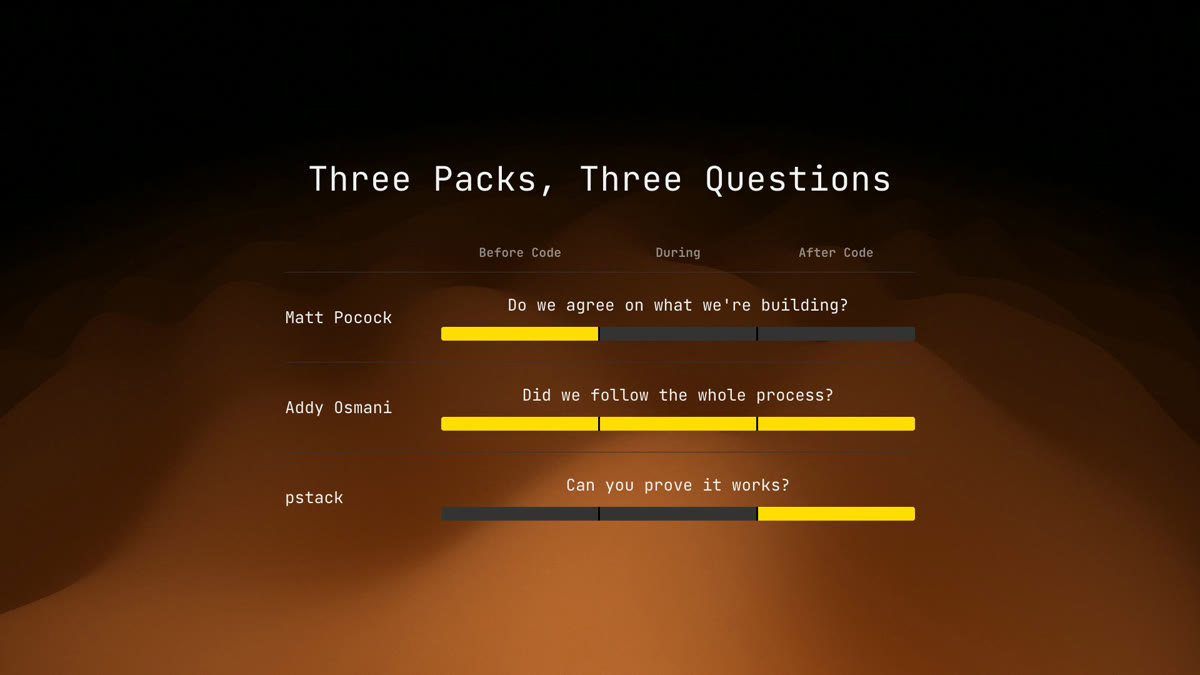
Matt Pocock: "Do we agree on what we're building?"
Matt's weight sits before the code. His most popular skill, /grill-me, has the agent interrogate you until you both know what you're building. From there it's a shared glossary, decision records, a spec and tickets. For big, fuzzy features there's Wayfinder, which maps out the "fog of war" before anyone writes code.
He's openly anti-framework. The skills are small and composable, and you're meant to hack them.
Reach for Pocock when requirements are fuzzy, you're working on a codebase you'll live with for years, or you want to stay in control of the design. If you only install one skill from any pack, make it /grill-me.
Addy Osmani: "Did we follow the whole process?"
Addy's pack is the most traditional of the three, and that's a compliment. It's a six-stage lifecycle with a slash command for each stage: Define, Plan, Build, Verify, Review, Ship (/spec, /plan, /build, /test, /review, /ship). No new vocabulary to learn. It's the software development lifecycle done properly, with an agent.
Two things stood out to me:
/build auto. You approve the plan once and it runs every task on its own. But each task is still test-driven and committed separately, and it stops when something fails. It removes you from between the tasks, not the tests. That's the right kind of autonomy.- Anti-rationalization tables. Every skill lists the excuses an agent will make to skip a step ("This is too simple to test", "I tested it manually"), with the rebuttal right next to each one. Steal this idea for your own skills.
It's also the most portable pack. It installs into around 70 different agents with npx skills add addyosmani/agent-skills.
Reach for Addy when you're on a team, shipping to production, and want a predictable process everyone recognises, with quality gates you didn't have to design yourself.
pstack: "Can you prove it works?"
Lauren deliberately ships no planning skills. Her line is "the best spec is code." All the weight is on investigation, verification and multi-model review. "The build passed" doesn't count as evidence.
Reach for pstack when it's gnarly: a bug you can't reproduce, a migration, an overnight run you need to trust in the morning. It's also the natural fit if you're in Cursor running several models.
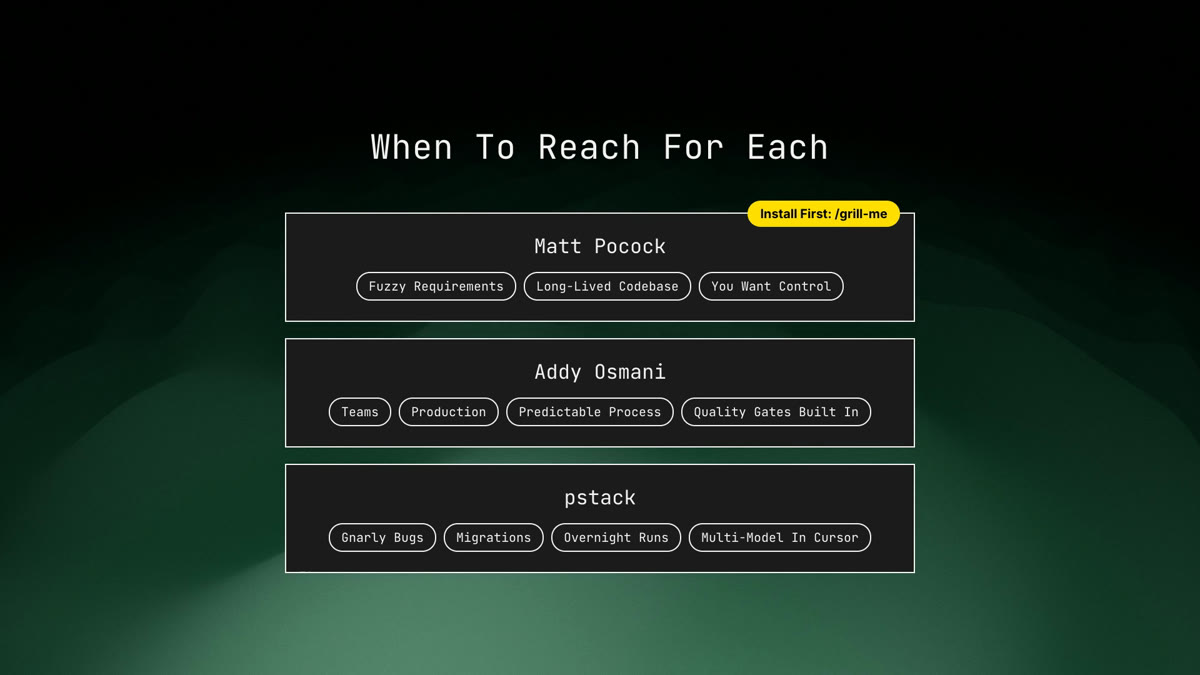
The receipt that changed my thinking
The Gray Cat ran a great experiment. They gave Addy's skills and Matt's skills the exact same feature, from the same commit, with the same model. For Matt, they picked the heaviest path, Wayfinder.
Wayfinder spent 102 minutes and 34.9 million tokens planning before writing any code. When the app launched, the RUN button was disabled, which was the most obvious thing on the screen.
Addy's run got to a working app faster. Then review rejected the work three times, and verification used more tokens than the build itself.
The final bill: $87.25 for Pocock, $86.46 for Osmani. Same money, spent in completely different places. One paid up front in planning, the other paid at the end in review.
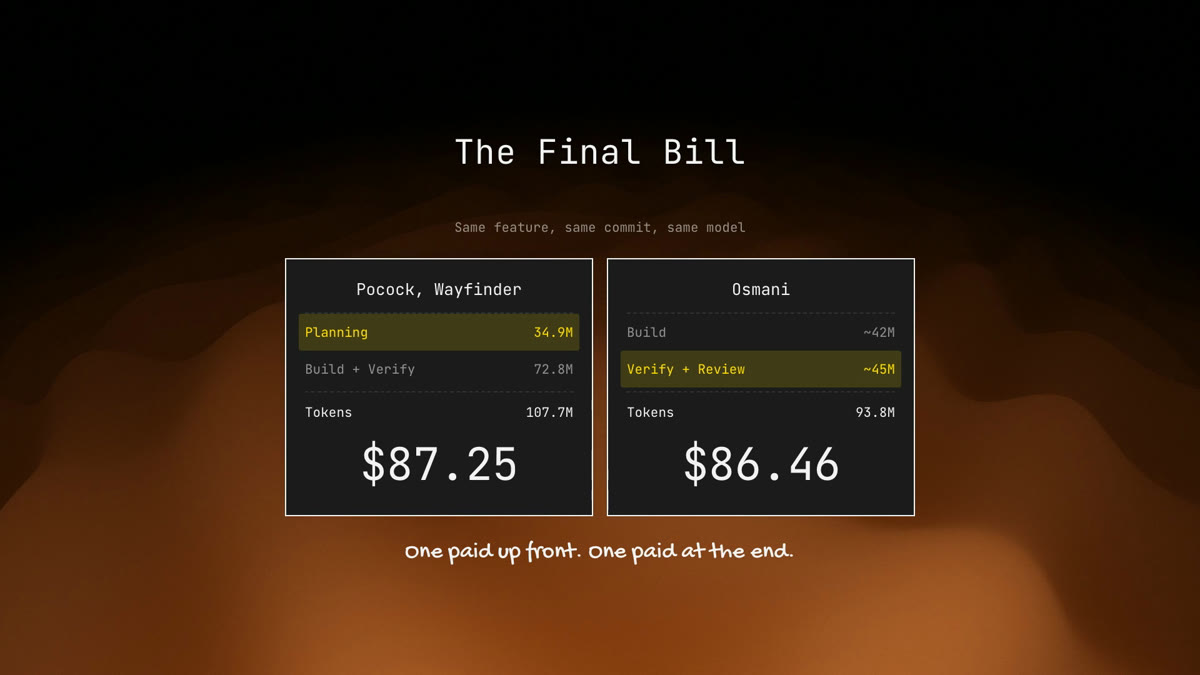
Their conclusion, which I agree with: smaller phases, with a human clicking around to verify in between, would probably have beaten both.
So, when do you use each?
Don't run any of these packs at full weight on every task. The ceremony should match the stakes:
- Small tweak: no skills. Just do it, then check it yourself.
- Small feature: a quick
/grill-meso you're aligned, plus TDD. - Big or fuzzy feature: spec and plan (Pocock or Addy), broken into phases you verify in between.
- Production, security or anything irreversible: Addy's full review, doubt-driven development and security hardening. Add pstack's verification if a wrong answer is expensive.
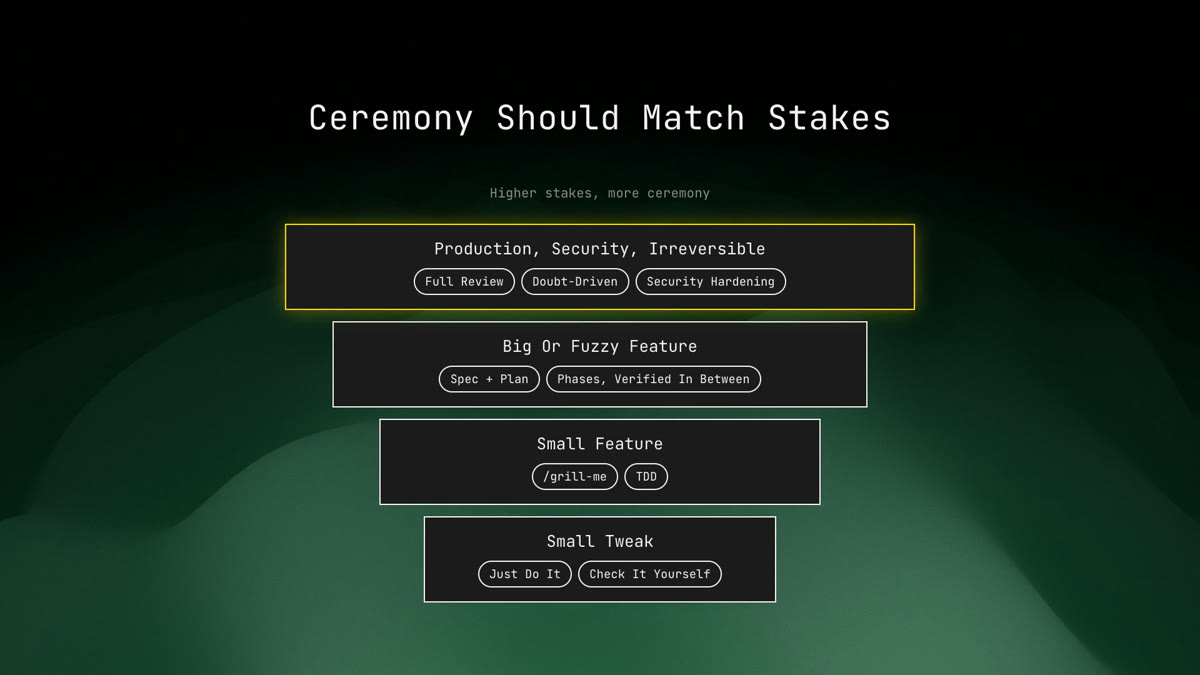
Even Addy says this. His adoption guide recommends a gradual, verification-first rollout on existing codebases, not "install all 25 skills and run everything."
There's a cost to over-installing, too. Every skill is something the agent has to consider, and auto-triggering skills can fire when you don't want them. More skills doesn't mean a smarter agent.
Treat them as a textbook, not a religion
All three packs are good engineering practice written in a format an agent can follow: TDD, small vertical slices, agreeing on requirements before you build, writing down why you decided something, proving it works against the real thing. Addy's pack is essentially Software Engineering at Google for agents.
So install them, read them, and steal what works. Then build your own skills on top that encode how you work.
And the next time an agent gets something wrong, don't swear at it. Update your skill. That's how all three of these packs were built.
Tell me in the comments on the video: which pack are you running right now, and have you written a skill of your own yet?
If you want to go deeper on building your own skill library and agent workflows, that's what we do in the Switch Dimension Accelerator.